

A Christmas Eve telegram sent by the Canadian Ambassador Ken Taylor to Michael Shenstone, Director-General of African and Middle Eastern Affairs at External Affairs Canada, details an unexpected aerial infiltration over Iranian airspace, and brings a bit of light to a dark holiday season. This message, along with Shenstone’s papers, is preserved in the Trinity College Archives.
On November 4, 1979, Iranian students and supporters of the Ayatollah Khomeini stormed the Embassy of the United States in Tehran, taking 66 American diplomats and other civilian personnel hostage. But six American diplomats evaded capture, and within days found refuge with Canadian Ambassador Ken Taylor and his Chief Immigration Officer John Sheardown. For weeks, the Canadians sheltered the American “houseguests” as risks grew, and leaks and speculation threatened to expose their position. By mid-December, Taylor pressed for exfiltration, but U.S. officials responded that the houseguests should stay put until they had a good chance of safe departure, leaving the fate of the Americans uncertain.
On December 24, 1979, a telegram went out from Ambassador Ken Taylor at the Canadian Embassy in Tehran to Michael Shenstone, director-general of African and Middle Eastern Affairs at External Affairs in Ottawa. The two men had been in frequent, near daily contact, since the houseguests had arrived, with Shenstone working on the Ottawa side to coordinate strategies to shelter and protect the Americans. The subject header of the telegram was ominous:
“Aerial infiltration”.
It went on to describe a dramatic interception of an unknown aircraft by the Iranian air force. The pilot carried no identification papers, and was detained on charges of overflight without permission, illegal entry, and smuggling.
Surely this was a moment that threatened to ignite a major international crisis between Iran and the west? With the country engulfed in revolutionary turmoil, the recent seizure of the American Embassy still fresh, and the looming threat that the houseguests would be discovered, this aerial infiltration could escalate tensions to a dangerous breaking point.
But several less-than-subtle hints indicate that the telegram was sent in jest – a lighthearted attempt to ease some tension during a dark season. The pilot of the unidentified craft was identified as Nicholas Myra (or Saint Nick, if you like). And along with his other charges of illegal entry and smuggling, the pilot was also charged with importing reindeer without proper veterinary clearances. The bow on the telegram? “Merry Christmas from Teran.”
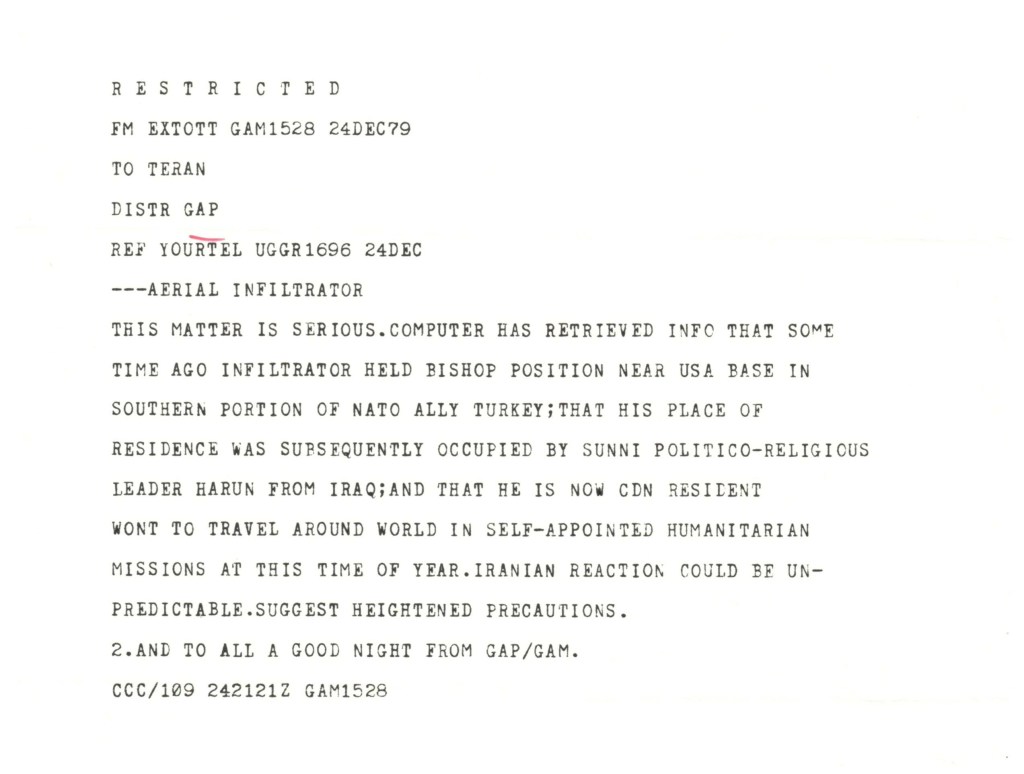
Shenstone’s response was equally tongue in cheek: “This matter is serious” he replied. He noted that the pilot was “now Cdn resident wont to travel around world in self-appointed humanitarian missions at this time of year” and that “Iranian response could be unpredictable.” He urged heightened precautions, closing with “And to all a good night.”
While the six American diplomats were successfully exfiltrated on January 27, one should not underestimate the precariousness of the situation that Taylor, Sheardown, and Shenstone found themselves in over Christmas of 1979. By sheltering the Americans, they were risking their careers, and in some cases, their lives. That they found camaraderie, even joy in such perilous times is remarkable, and speaks to the true spirit of the season.
These telegrams, along with Michael Shenstone’s papers that illuminate the Canadian Caper, are preserved in the Trinity College Archives.
 John W. Graham Library News