
With the 100th anniversary of the opening of Trinity College at 6 Hoskin Avenue having just passed, many of the staff have turned to the Archives for inspiration on how to mark this milestone. And what better way to celebrate than with a feast?
When a colleague asked me for menus from 100 years ago, I knew the Archives could help bring history to the table. The request was for a special throwback High Table dinner for students, held November 11 in Strachan Hall, in honour of the 100th anniversary of the opening of 6 Hoskin Avenue. Digging into our collections, I uncovered menus that reflected the tastes of the times. From the 1923 Cornerstone Laying Ceremony, the 1925 College Athletic Dinner, and Trinity’s 75th Anniversary Dinner in 1927, one thing was clear: oyster soup was a banquet favorite. Celery and olives dominated as appetizers, while ice cream reigned as the go-to dessert.
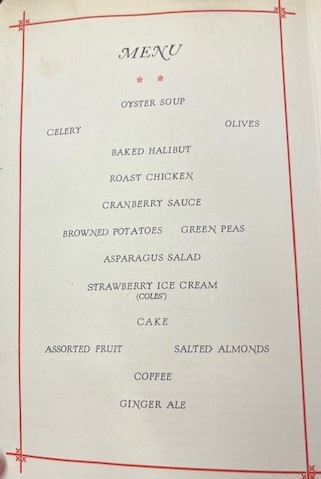
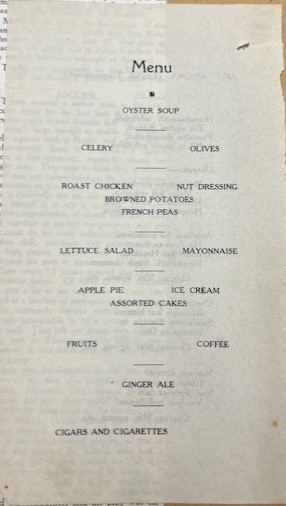
Menus from the Trinity College 75th Anniversary Dinner (1927) and the Trinity College Athletic Dinner (1925). F2306 Scrapbook Collection. Trinity College Scrapbook Vol. 1 1920-1926
I also found menus featuring everyday student fare. In the late 1930s, students at Trinity House (the men’s residence at St. George and Harbord before the College had its own residence wings) formed a food committee to investigate what they suspected was “inefficiency in the management of the kitchen department.” Their reports echo complaints familiar to student diners today: meals were too starchy, desserts monotonous, and the fish “inferior.”
Part of the committee’s investigation was to undertake a comparative study of the meals offered at Trinity House, Knox College, Burwash Hall, St. Mike’s, and Hart House. A typical Trinity House dinner included soup, two meats, two vegetables and potatoes, two desserts, and coffee. Knox residents, by contrast, had no soup, no choice of meat, and no choice of dessert—though their plan was $1.50 cheaper per week. Menus for St. Hilda’s College were even more detailed: the week of October 17–23, 1938 featured stewed prunes for breakfast and boiled tongue for dinner.
Ultimately, the committee concluded Trinity’s higher price was justified by quality and quantity of food on offer, but they made several recommendations, including one that stands out: “That pan-cakes be served more often for breakfast than is the custom at present.” Well, indeed.
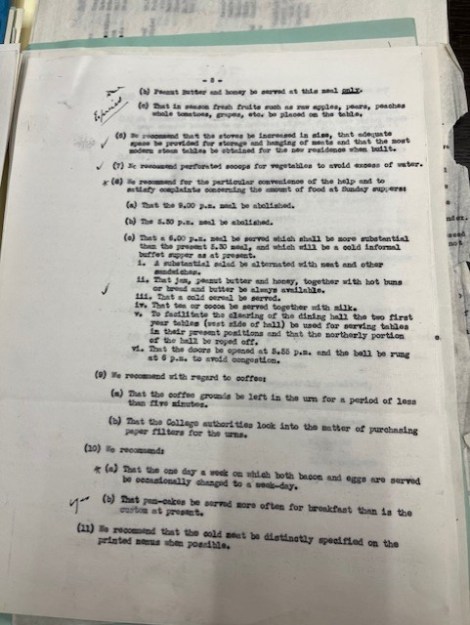
F1004. Office of the Bursar Fonds. Bursar’s Correspondence, 1931-39.
While the High Table dinner did not serve up a literal interpretation of these 1920s and 1930s menus, the historical details certainly became inspiration for the event, and it connected students with the College’s history in a tangible, and delicious way.
 John W. Graham Library News