
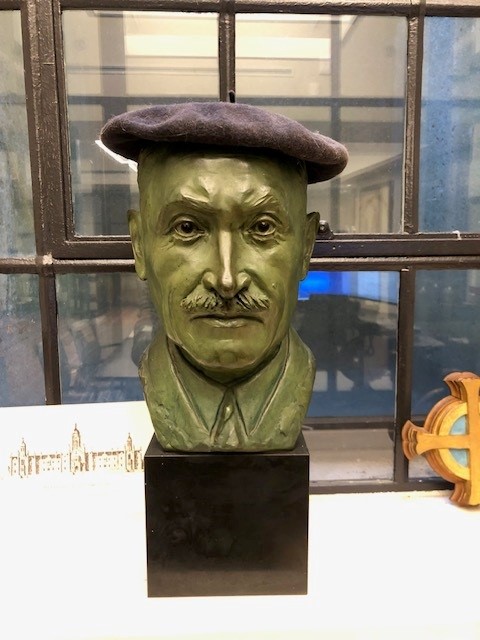
Visitors to the archives often ask me about the portrait bust that graces the windowsill of my office, along with an assortment of oddities that are difficult to house. The query is often prompted by the presence of a classic wool beret at a rakish angle adorning the fine-looking head of the subject.
I’m delighted to share my office with Count Paul Ignatieff, father of our 9th Provost, George Ignatieff, and grandfather of Michael and Andrew. The archives holds the papers of all three members of the family, and each set of papers includes a great deal of information about Count Paul, complete with photographs, memoirs, legal records, and letters. The papers document the dramatic escape from Russia in 1917, and the pre-Revolutionary family history. These photographs and papers form the basis of Michael Ignatieff’s Russian Album, published in 1988. Alison Ignatieff’s distinguished forebears, the Grant and Parkin families, are also represented and chronicled in the archives.
George Ignatieff donated his papers to the Trinity Archives before his death, and additional family material from both sons has come in over time. Michael Ignatieff began donating his papers in 2011. They include material from his life as a public intellectual, historian, biographer, academic, and politician. Andrew Ignatieff’s papers came to us after his death in 2022, the gift of his brother. These papers document Andrew’s work for UNICEF in the developing world and his own beautiful writing about his family and other matters.
And the letters! Remarkable letters between parents and children, thoughtful, articulate and revelatory, complementing each other and adding richness and complexity because several sides of the story are present. Long letters that capture family ties, travel, friendships, a mix of the personal and professional that give shape and context to their lives and the times they inhabit.
Count Paul came to the archives after the death of Andrew and has lived on the windowsill ever since. The beret, it seems, was always present in the family home and so it remains. The sculptor, Sarah G. Baker, has faded in memory – I haven’t been able to find anything out about her. I enjoy the Count’s company, and the reminder of the extraordinary depth of the collections he represents.
 John W. Graham Library News